LITERATURE WORK
*Question one:
Yes! I have been betrayed. What an experience it was.
*Question two:
Who would think that their own flesh and blood would betray them? As young people we tend to be popular and have many friends. Well, I was popular and had many friends but I trusted none. Instead I put my trust in my cousin who was in the same class as I was. I am a singer and many people along with my family and friends praise me for my singing but at the same time many grudged me, not knowing my cousin was one of the many who did.
There was this guy I loved and we were good friends but we had a special love for each other. She (my cousin) found out about him from her friends and decided that she was going to be an antagonist. After a while the guy became less close to me than he normally was, so I began to ask questions. I asked, “Why are you so distant from me now- a- days?” He replied, “You think you can play me because you’re the girl every boy wants in this school to sing them sweet songs and dey wid. I was informed about you” and he ended the relationship and he walked away. I was shocked to my bones and puzzled like the pieces of a puzzle trying to figure out what happen here.
Of course like every girl would do, I cried. Tears rolled down my cheek but even then I was furious and angry. I could have just chopped him with a big stone. Whenever he sees me there was still this look of love in his eyes for me but he would never approach me.
The week ended and the following Monday news can to me like ABS TV. The reason for the break up between me and the guy was my COUSIN! Oh my sweet Jesus, I was ready to pelt with stones like the woman in the Bible. She betrayed me and knows how much that guy means to me. She bad talked me to the guy and told him that I was going around this other guy in the village and knowing that we are family he believed her easily without a doubt. What a liar! At that point in time I was ready to strike down and box her like am in a boxing ring. I confronted her and she admitted to it, that she was the reason for the break up. It turned out that she was jealous of me and the guy that I loved she had a crush on him. You never know who to trust but the Bible says, “Turn your eyes upon Jesus”. Trust in no man but the Lord.
*Question three:
The question is asked, “Have you ever been betrayed and misunderstood the situation?” My answer to that question would be, yes! Of course I’ve been betrayed, I mean who haven’t. Let me guide into to how it all went down.
I was young and had many friends, popular I should say. There was this one friend I held close to me and dear to my heart. Soon enough that dearness took a quick turn into hatred. There was a rumor floating around about my friend (best friend) talking negatively behind my back. Now, if you have so much people saying the same thing, there is no other option but to believe it. So I confronted her and I bet you know what went down. I cursed her out, how dear she backstab me like that after all the things I’ve done for her. The conflict went on for weeks until our mothers were involved.
However, we both decide to resolve the problem. While doing so we found out that it was all a misunderstanding. Some of my friends were talking behind my back and she was the only one to stand up for me. She confronted them and told them that she was going to tell me how they were betraying and talking me. Before she could have informed me about their doings, they rushed to me and tell me that it was my best friend who was talking behind my back. I felt like the world has turned against me because my best friend has betrayed me. Now foolish I, believing them turn against the only one who stood up for me when they were spoiling my name. I apologize and she forgave me and up to this day we are still the best of friends.
These are the days when my mother’s words of wisdom would make perfect sense. “Don’t go around claiming people as friends, instead keep them as acquaintances!”
*Question four:
Observing the various Shakespeare plays the characters always resort to violence, trickery and evilness because of the antagonist or villain in the story or play. He/she always begins a conflict between the characters of the book to please his/her self which leads to numerous problems in the story.
For example:
1. In the book “Much Ado About Nothing”, Don John creates an evil plan to cause conflict between Hero and Claudio who is to wed the next day. his plan to destroy the lives of others caused Claudio's lover, Hero, to be shamed in front of the entire nation and eventually she was believed to be dead by the other characters of the book.
2. In the book “Othello”, Iago turns Othello against his wife. He Iago says that Othello’s wife is having an affair with Cassio his former Moor’s Officer, thus creating jealousy from Othello towards his wife.
*Question five:
Date Written: 1610 or 1611.
First Performance: Probably May 15, 1611, at the Globe Theatre.
First Publication: 1623 as part of the First Folio, the first authorized collection of Shakespeare's plays.
The Winter's Tale is a play by William Shakespeare, originally published in the First Folio of 1623. Although it was grouped among the comedies, some modern editors have relabeled the play as one of Shakespeare's late romances. Some critics, among them W. W. Lawrence, consider it to be one of Shakespeare's "problem plays", because the first three acts are filled with intense psychological drama, while the last two acts are comedic and supply a happy ending.
Nevertheless, the play has been intermittently popular, revived in productions in various forms and adaptations by some of the leading theatre practitioners in Shakespearean performance history, beginning after a long interval with David Garrick in his adaptation called Florizel and Perdita (first performed in 1754 and published in 1756. The Winter's Tale was revived again in the 19th century, when the third "pastoral" act was widely popular). In the second half of the 20th century The Winter's Tale in its entirety, and drawn largely from the First Folio text, was often performed, with varying degrees of success.
. The Winter's Tale is traditionally classed as a comedy because the play ends happily. First, the protagonist, King Leontes, reconciles with a friend he had earlier rejected. Then he reunites with his wife, who was thought dead. However, the play is probably better classed as a tragicomedy because, preceding the happy ending, the king's little boy dies, a bear kills a faithful lord of the court, and Leontes suffers a humiliating downfall before realizing and acknowledging mistakes he has made.
*Question six:
Elizabethan Theatre
Elizabethan theatre and the name of William Shakespeare are inextricably bound together, yet there were others writing plays at the same time as the bard of Avon. One of the most successful was Christopher Marlowe, who many contemporaries considered Shakespeare's superior. Marlowe's career, however, was cut short at a comparatively young age when he died in a tavern fight in Deptford, the victim of a knife in the eye.
Theatre had an unsavory reputation. London authorities refused to allow plays within the city, so theatres opened across the Thames in Southwark, outside the authority of the city administration.
The first proper theatre as we know it was the Theatre, built at Shoreditch in 1576. Before this time plays were performed in the courtyard of inns, or sometimes, in the houses of noblemen. A noble had to be careful about which play he allowed to be performed within his home, however. Anything that was controversial or political was likely to get him in trouble with the crown!
After the Theatre, further open air playhouses opened in the London area, including the Rose (1587), and the Hope (1613). The most famous playhouse was the Globe (1599) built by the company in which Shakespeare had a stake.
The Globe was only in use until 1613, when a canon fired during a performance of Henry VIII caught the roof on fire and the building burned to the ground. The site of the theatre was rediscovered in the 20th century and a reconstruction built near the spot.
These theatres could hold several thousand people; most standing in the open pit before the stage, though rich nobles could watch the play from a chair set on the side of the stage itself.
Theatre performances were held in the afternoon, because, of course, there was no artificial lighting. Women attended plays, though often the prosperous woman would wear a mask to disguise her identity. Further, no women performed in the plays. Female roles were generally performed by young boys.
The Elizabethan Era!
The English Elizabethan Era is one of the most fascinating periods in the History of England. The Elizabethan Era is named after the greatest Queens of England - Queen Elizabeth I. The Elizabethan Era is not only famous for the Virgin Queen but also for the era itself - Great Explorers, such as Sir Francis Drake and Walter Raleigh. The era of the very first Theatres in England - William Shakespeare, the globe Theatre and Christopher Marlowe! The people of the era - the Famous Figures who featured in the history of this era such as the Queen's love Robert Dudley, the sinister Dr. John Dee, the intrigues of the spy-master Sir Francis Walsingham and the Queen's chief advisor Sir William Cecil (Lord Burghley). Religion - Politics - Executions - Crime and Punishment all played their part in the Elizabethan era! And so did the commoners!
*An image of the Elizabethan Theatre.
The Globe theatre
The Globe was owned by actors who were also shareholders in Lord Chamberlain's Men. Two of the six Globe shareholders, Richard Burbage and his brother Cuthbert Burbage, owned double shares of the whole, or 25% each; the other four men, Shakespeare, John Heminges, Augustine Phillips, and Thomas Pope, owned a single share, or 12.5%. (Originally William Kempe was intended to be the seventh partner, but he sold out his share to the four minority sharers, leaving them with more than the originally planned 10%). These initial proportions changed over time as new sharers were added. Shakespeare's share diminished from 1/8 to 1/14, or roughly 7%, over the course of his career.
The Globe was built in 1599 using timber from an earlier theatre, The Theatre, which had been built by Richard Burbage's father, James Burbage, in Shoreditch in 1576. The Burbages originally had a 21-year lease of the site on which The Theatre was built but owned the building outright. However, the landlord, Giles Allen, claimed that the building had become his with the expiry of the lease. On 28 December 1598, while Allen was celebrating Christmas at his country home, carpenter Peter Street, supported by the players and their friends, dismantled The Theatre beam by beam and transported it to Street's waterfront warehouse near Bridewell. With the onset of more favourable weather in the following spring, the material was ferried over the Thames to reconstruct it as The Globe on some marshy gardens to the south of Maiden Lane, Southwark. The new theatre was larger than the building it replaced, with the older timbers being reused as part of the new structure; the Globe was not merely the old Theatre newly set up at Bankside. It was probably completed by the summer of 1599, possibly in time for the first production of Henry V and its famous reference to the performance crammed within a "wooden O".The first performance for which a firm record remains was Jonson's Every Man out of His Humour—with its first scene welcoming the "gracious and kind spectators"—at the end of the year. On 29 June 1613 the Globe Theatre went up in flames during a performance of Henry the Eighth. Theatrical cannon, set off during the performance, misfired, igniting the wooden beams and thatching. According to one of the few surviving documents of the event, no one was hurt except a man whose burning breeches were put out with a bottle of ale.] It was rebuilt in the following year. Like all the other theatres in London, the Globe was closed down by the Puritans in 1642. It was pulled down in 1644, or slightly later—the commonly cited document dating the act to 15 April 1644 has been identified as a probable forgery—to make room for tenements.
*Images of the Globe Theatre.
*Question seven:
 The Theater of the Absurd
 The Theatre of the Absurd is a style play for the theatre that was developed in the 1950s by writers such as Samuel Beckett, and Ionesco, whose work expresses the belief there is no God, and that human existence has no meaning or purpose. These plays are very different from traditional theatre. The characters do not communicate effectively with each other, and often their words do not make sense. Waiting for Godot is the best known example of these types of theatres.

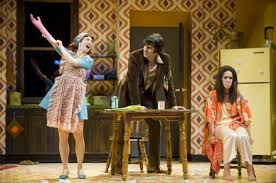
In these plays, the dramatists used illogical situations, unconventional dialogue and minimal plots to express the apparent absurdity of human existence. There existed no formal “absurdist movement” in the theatre. Dramatists whose works fell under the category had a pessimistic vision of humanity struggling vainly to find a purpose in life and to control its fate. The existential philosopher, Albert Camus, and other philosophers such as Jean-Paul Sartre used the term absurd to express their inability to find any rational explanation for human life. The dramatic works of certain European and American dramatists of the 1950s and 1960s have been referred to as the “Theatre of the Absurd”. This was so because they essentially subscribed to the theory proposed by Albert Camus, in his essay The Myth of Sisyphus. |
|
|
The works of well-known dramatists such as Samuel Beckett, Eugene Ionesco, Jean Genet, Arthur Adamov, Harold Pinter and a few others have been classified under the “Absurd” Theatre. A British scholar Martin Esslin, in his critical study of Samuel Beckett and French playwrights Eugène Ionesco, Jean Genet and Arthur Adamov, first used the term “Theatre of the Absurd”. Since the ideas dictated the structure of the plays, such playwrights did away with logical structures such as those exist in conventional theatre. Dramatic action, as conventionally associated with theatre and plays is in small doses, although the players continue to perform. It is one way of conveying that whatever they did, nothing will change their existence or fate. For instance, there is no specific storyline or plot in Samuel Beckett’s Waiting for Godot. The play revolves around two tramps, who are apparently lost and who are filling their days waiting for somebody called Godot. Who was Godot, when he would come and whether he would come at all are issues to which they have no answer. The absurdity of life and living is subtly brought out. As mentioned earlier, dialogues are usually unconventional. The language is dislocated and there are generous doses of clichés, puns and repetitions. A classic example is Ionesco’s The Bold Soprano, where two characters keep repeating the obvious until it sounds like nonsense. The effect is to bring out the inadequacies of verbal communication. The two characters discuss banal matters and end up discovering that they are man and wife. It is one of the most classic example of how Ionesco used his genius to bring the out the inadequacies of verbal communication and the theme of self-estrangement. The ridiculous behavior and talk of the two characters lends the play a comic surface, but deep beneath lies the message of metaphysical distress. The Absurd Theatre began to decline in the mid-1960s. Although it shocked the audiences when it first appeared, many of its characteristic features were absorbed in mainstream theatre, when the Absurd Theatre declined. The techniques used are now common in modern theatre. |
|
*Question eight:
William Shakespeare
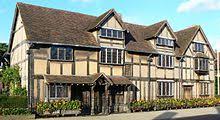
 Shakespeare was born on the 23rd April 1564 on Henley Street in Stratford, England, a bustling market town on the Upper Avon River in the county of Warwickshire, about ninety miles northwest of London.. Elizabeth I was in the sixth year of her reign as Queen of England. On April 26, Shakespeare was baptized in Stratford’s Holy Trinity Church with a surname that omitted the first “e”: Shakspeare. He was the third of eight children (four girls and four boys) of John Shakespeare and Mary Arden Shakespeare, who married in 1557. John Shakespeare, a native of nearby Snitterfield, crafted gloves, lent money, and traded in wool, barley, timber, and leather goods in a shop next to his Henley Street home. He also served as Stratford’s official ale-taster. As a conscientious and respected citizen, he held sundry political offices, including those of constable, treasurer, and alderman. In 1567, he became the high bailiff, or mayor, of Stratford, known in modern times as Stratford-Upon-Avon. Mary Arden Shakespeare was the daughter of a prosperous farmer of good social standing in the nearby town of Wilmcote. She was a good catch for John, for she possessed the greatest feminine charm of all: money. .......
*This is where Shakespeare lived and grew up.
William Shakespeare may have enrolled at a preschool, comparable to the modern kindergarten, to study catechism and the basics of reading and writing. Between ages seven and thirteen, he probably attended a local grammar school, the King's New School, to study classical history, religion, ethics, logic, rhetoric, public speaking, Roman poetry and drama, the natural sciences, and other subjects taught in Latin by well-trained teachers from Oxford University. It is likely he also studied the New Testament of the Bible in Greek.
........Because of the broadness and excellence of their education at the Stratford school, its graduates developed a strong grasp of the liberal arts, perhaps stronger even than that of modern high-school graduates. So it was that the adolescent Shakespeare—if he did indeed attend the Stratford school—arrived at early manhood well grounded in academic learning. What is more, he possessed a goodly headful of bucolic savvy, for his plays testify to his knowledge of hunting, hawking, and the appetite of worms in rural cemeteries. Most important, though, he had a knowledge of people and the everyday life that surrounded him, gleaned no doubt from observing the farmers, butchers, fruit and vegetable vendors, carpenters, shoemakers, candlemakers, tailors, jugglers, barbers, physicians, sorcerers, clergymen, gravediggers, tax collectors, and actors who regularly converged on Stratford to labor for coin of the realm, divine favor, or applause. While Shakespeare was testing his writing talent, it is quite possible that roving actors who performed every year at a Stratford guild hall enkindled in him an enthusiasm for acting and the stage. The actors in the "play within in a play" in Hamlet, Prince of Denmark may have been based on actors who visited Stratford.
.......In 1582, he was 18, William Shakespeare married Anne Hathaway, 26, the daughter of a thriving farmer in the village of Shottery, about a mile from Stratford. The wedding took place in a church at Temple Grafton, near Stratford. Hathaway was pregnant at the time of the marriage. In May 1583, they had a daughter, Susanna, and in 1585, twins, a boy named Hamnet and a girl named Judith. Hamnet died 11 years later.
The Lost Years
What Shakespeare did between the middle 1580s and 1592 is unknown because no records of his activities during that period have emerged. It is possible he spent this entire period in London after leaving Stratford to escape a charge of deer poaching in a park belonging to Sir Thomas Lucy, of Charlecote, near Stratford. However, that possibility springs from sheer speculation, because it has never been proven that Shakespeare did, in fact, commit the crime. During these ''lost years," as they have come to be called, Shakespeare might have tended horses for theatergoers or worked as a sailor, a teacher, or a coachman. Or he might have been a soldier, a law clerk, a theater page, or a moneylender. He could have held several of those jobs. He may have held none of them.
.......Shakespeare may also have spent the time traveling to distant towns or even to foreign countries. His plays suggest that he visited Italy, for more than a dozen of them—including The Merchant of Venice, Romeo and Juliet, All's Well That Ends Well, Othello, Coriolanus, Julius Caesar, The Two Gentlemen of Verona, The Taming of the Shrew, Titus Andronicus, Much Ado About Nothing, and The Winter's Tale all have scenes set in Italy. In addition, plays not set in Italy often star characters with Italian names. For example, although The Comedy of Errors takes place in Ephesus, Turkey, the names of many of the leading characters end with the Italian o or a:—Angelo, Dromio, Adriana, Luciana. In Hamlet's Denmark are characters named Bernardoand Francisco. Most of the characters in Timon of Athens bear the names of ancient Romans with the distintive us ending—Lucullus, Flavius, Flaminius, Lucius, Sempronius, Servillius, Titus, Hortensius, Philotus. Characters in Twelfth Night, set along the Adriatic coast, include Duke Orsino, Malvolio, Curio, Maria, and Antonio. The Tempest, although set on a magical island, has a largely Italian cast, including Prospero, Miranda, Antonio, Alonso, Gonzalo, Trinculo, and Stephano. Of course, it is quite possible that Shakespeare visited Italy only in his imagination, which was boundless.
Died on Birthday
7Shakespeare retired from the theatre in 1610 and returned to Stratford. Six years later, in 1616, he died on the same date on which he was born, April 23. The cause of his death is the subject of conjecture. Ironically, he pronounced himself in good health on March 25, 1616, just a month before he died. According to John Ward, a Stratford vicar in the mid 1600's, Shakespeare came down with a fever after a drinking bout with Ben Jonson and John Drayton, who had come to Stratford from London to visit him. Another story suggests that Thomas Quiney, the husband of Shakespeare's daughter Judith, poisoned Shakespeare. (Shakespeare may have altered his will in 1616 to insert a condition stating that Quiney would not be entitled to Judith's inheritance.) Shakespeare was entombed in the chancel of the same church where he was baptized. His wife died in 1623 at age 67. On his tombstone in Holy Trinity Church are engraved these words which appear to have been written by Shakespeare himself:
Good friend, for Jesus' sake forbear
To dig the dust enclosed here.
Blest be the man that spares these stones,
And curst be he that moves my bones.
.......After Shakespeare's death, his friends and relatives placed a monument on the wall above his tomb. The Latin words inscribed on it (Judicio Pylium, genio Socratem, arte Maronem, Terra tegit, Populus mæret, Olympus habet) praised him for having the wisdom of Nestor, the intellect of Socrates, and the writing genius of the Roman poet Publius Vergilius Maro (Vergil). In 1623, Ben Jonson wrote of Shakespeare:
Triumph, my Britain, thou hast one to show
To whom all scenes of Europe homage owe.
He was not of an age, but for all time!
*Books written by Shakespeare and around the time they were written.
History themed:
· King Henry IV part 1- c. 1597
· King Henry IV part 2- c. 1597
· King Henry V- c. 1598
· King Henry VI part 1- c. 1590-2
· King Henry VI part 2- c. 1590-2
· King Henry VI part 3- c. 1590-2
· King Henry VIII- c. 1613
· King John- c. 1595
· King Richard II- c. 1595
· King Richard III- c. 1593
Tragedy themed:
· Antony and Cleopatra- c. 1606
· Coriolanus- c. 1608
· Hamlet- c. 1601
· Julius Caesar- c. 1599
· King Lear- c. 1605
· Macbeth – c. 1606
· Othello- c. 1604
· Romeo and Juliet- c. 1595
· Timon of Athens- c. 1608
· Titus Andrornicus- c. 1594
Comedy themed:
· Alls Well That Ends Well- c. 1602
· As You Like It- c. 1599
· Comedy of Errors- c. 1592
· Cymbeline- c. 1610
· Love’s Labor’s Lost- c. 1594
· Measure for Measure- c. 1604
· Merchant of Venice- c. 1596
· Merry Wives of Windser- c. 1599
· Midsummer Nights Dreams- c. 1595
· Much Ado About Nothing- c. 1599
· Pericles, Prince of Tyre- c. 1608
· Taming of the Shrew- c. 1593
· The Temptest- c. 1611
· Troilus and Cressida- c. 1602
· Twelfth Night- c. 1600
· Two Gentlemen of Verona- c. 1594
· Winter’s Tale- c. 1610/11

