Wednesday, November 24, 2010

*Much Ado About Nothing Summary* Act 1 - 3

Act One
A messenger reported to Leonato (the governor of Messina), that the Prince of Arragon, Don Pedro, is coming to Messina. Leonato asked the messenger, how many men did he loose in this action and his response was, a few men but none of importance and everyone began to prepare for the arrival of Prince.
Don Pedro and his men entered and were greeted by Leonato and company. They both shared and expressed gratitude and greetings and during that process, Hero (Leonato’s daughter) was introduced. Beatrice, Leonato’s niece and Benedick, a young lord of Padua; when in each other’s presence, they argue about the thing that most people always search to find, which is love. Everyone is entertained by them arguing and Claudio, a young lord of Florence, is caught up in Hero’s beauty. Finally the argument was over and Don Pedro announces that they are staying in Messina for at least a month.
Claudio and Benedick are left alone and Claudio asked Benedick, if he had noticed Leonato’s daughter, Hero. Benedick replied that he did not notice her but yet he looked upon her. Claudio insisted that Benedick answer him truthfully and so he (Benedick) did. Don Pedro entered and asked what the conversation was about and he was answered by Benedick. Don Pedro’s response was one that Benedick did not expect, so ‘carried on’ and stated that he will never fall in love. Don Pedro explained to Claudio that if he love Hero, to cherish it and he (Don Pedro) will break with Hero and her father and tell them that he (Claudio) wishes to marry Hero and then she shall be his.
One of Don John’s (Don Pedro bastard brother) men, Borachio, overheard the conversation between Claudio and Don Pedro. He (Borachio) the reported what he heard to Don John and a plan was made to break up the love and stop the wedding of Claudio and Hero.


Act Two
It was dinner time, ball and dancing. Leonato, Beatrice, Antonio (Leonato’s brother) and Hero were having a conversation. Leonato reminded his daughter hero, that if the Prince asks her to marry, she knows what to say. Beatrice as always, says she will never get married and she will never fall in love. Leonato told her (Beatrice) to go to hell and she replied, not to hell but to the gate and there the devil will meet her and say she’s too good for hell so go to Heaven and sit where the bachelor’s sit.
Don Pedro then approaches Hero and asks her to walk with him and she agreed. As they walk, Balthasar (Don Pedro’s follower) interferes with Margaret (Hero’s gentlewoman) and Antonio interferes with Ursula (Hero’s gentlewoman).
Don John and his men approaches Claudio , who pretends to be Benedick, and tells him that the prince is trying to woo Hero for himself and he  swore his love for her and promises to marry her. Claudio now hearing all that has been said, believes it and builds up hatred and jealousy for the Prince, Don Pedro. After all that confusion, Claudio came face- to- face with Don Pedro with all that hatred and jealously stirring up inside him. He, Claudio, came to find out that the prince had math him and Hero together. After all that was said, Claudio and Hero unite.
Long after Beatrice had left their presence, Claudio, Leonato, Don Pedro and others made it their business to make Beatrice and Benedick fall in love. They created the plan in such a way that both Beatrice and Benedick will hear them talking privately about the love they both have for each other and eventually to both will and do fall in love with each other.

Act Three
Beatrice was walking through the garden, after inviting Benedick to dinner, overheard Hero and Ursula talking about how Benedick is madly in love with her. After hearing what was being said, she, Beatrice was now convinced that Benedick loved her.
Don Pedro, Leonato and Claudio teases Benedick about his new look and how he must be in love that’s why he shaved his beard. After all that was finished, Benedick and Leonato exits, leaving Claudio and Don Pedro alone but not for too long before Don John joins them. They were both informed about the Hero and her disloyalty which she plans to perform the same night, as they speak. Don Pedro and Claudio were taken by Don John to where he saw Hero in her act, being disloyal.
Borachio now calls Conrade (Don John’s follower) and told him about the plan of getting in bed with Margaret, who from Claudio’s and Don Pedro’s  angle looked like Hero, and that Claudio turned away angry, thinking it was hero and that he earned a thousand ducats from Don John for what he did. not knowing they were being heard by watchmen, they were arrested and held until matters were solved.
Everyone was getting ready for the big wedding and Leonato was interrupt from work by Dogberry about marriage but the conversation was cut short because Leonato had more wedding business undone.


Wednesday, November 17, 2010

*Much Ado About Nothing Assignment*

  1. The vow that Don John made was that he will woo Hero and make it his business to stop Don Pedro or Claudio from wooing Hero.
  2. Claudio is in love with Leonato’s daughter, Hero.
  3. The perspective of love between Benedick and Beatrice is that because they are always arguing when together. It is said that he will never love her and she will never love him. A plan was made to setup Benedick with Beatrice, hoping that as a result they will stop hiding their love for each other and fall in love and eventually they did.
  4. The plan executed by Don Pedro is to disguise as Claudio and woo Hero and in the end hook them up, which will eventually lead to Claudio marrying Hero (his love).


*Comments on the music:
1.    At the beginning of the movie the words spoken by Beatrice was accompanied by soft playing music.
2.    When Don Pedro, Benedick, Claudio, Balthasar and Don John were arriving, the music was hype and it also has an essence or meaning of when someone of royalty is making a grand entrance.
3.    The music is arranged or chosen to suit the words of the actors giving it a sense of sweetness or harshness.
Example: 
·         For soft words the music is soothing and sweet.
·         If the words are harsh, the music is rough and not soothing.

*Comparing the book and the movie.
In the text we read and maybe imagine differently from what is shown in the movie. 

The movie starts with Beatrice speaking among people, repeating the exact words of the song in act two, scene three, and page fifty- one but at the beginning of the text is a conversation with Leonato, his wife, Hero, Beatrice and a messenger about Don Pedro’s arrival.

Also, I noticed that certain parts of the movie, the actors repeat the exact words as in the text but in some parts of the movie some of the words are left out or not said as in the text.

The setting of the movie is also different, in some areas, to that of the text.

 Example:                                                                                                            
  • The first scene of the text (The conversation about Don Pedro’s arrival). You expect them to be in a setting where is them alone but not acquainted with no one else.


*What I have notice or realize about the actors of the movie, is that they are all or if not all, some are movie stars. The actors are not randomly chosen to act the part.              

Example:
  • Denzil Washington as Don Pedro.
  • Keanu Reeves as Don John (the bastard bother)                             

In the book the actors seem more of the century the book was written.

Wednesday, November 10, 2010

William Shakespeare.

* William Shakespeare was born at Stanford upon Avon in April, 1564. His parents were, John Shakespeare and Mary Arden. He was the third child and the eldest son. In 1582 in the month of December, Shakespeare married Ann Hathaway. Their first child, Susanna was baptized on May 6, 1583, and twins, Hamnet and Judith on February 22, 1585. 

Little is known of Shakespeare's early life; but it is unlikely that a writer who dramatized such an incomparable range and variety of human kinds and experiences should have spent his early manhood entirely in placid pursuits in a country town. By the summer of 1598, for the poet and playwright, Shakespeare is generally considered the greatest ever  and is also one of the least known of all literary figures and his works were indeed created for the popular entertainment of his day with little thought to their immortality. 

Shakespeare did not take any steps to preserve his writings past their immediate use. With all the academic study of Shakespeare and the trappings of fine culture that have been wrapped around productions of his dramas over the centuries, we often forget what an amazing, unique and entertaining spectacle his plays presented to their original audience — and still can to a modern audience, in the right hands. When Shakespeare died on the 23rd of April 1616 at the age of fifty- two (52), fourteen of his plays had been separately published n Quarto booklets.

Plays written by Shakespeare

* History themed plays:
  1. King Henry IV part 1
  2. King Henry IV part 2
  3. King Henry V
  4. King Henry VI part 1
  5. King Henry VI part 2
  6. King Henry VI part 3
  7. King Henry VIII
  8. King John
  9. Richard II
  10. Richard III
* Tragedy themed plays:
  1. Antony and Cleopatra
  2. Coriolanus
  3. Hamlet
  4. Julius Caesar
  5. King Lear
  6. Macbeth
  7. Othello
  8. Romeo and Juliet
  9. Timon of Athens
  10. Titus Andrornicus
*Comedy themed plays:
  1. Alls Well That End Well
  2. As You Like It
  3. Comedy of Errors
  4. Cymbeline
  5. Love's Labor's Lost
  6. Measure for Measure
  7. Merchant of Venice
  8. Merry Wives of Windsor
  9. Midsummer Nights Dream
  10. Much Ado About Nothing
  11. Pericles, Prince of Tyre
  12. Taming of the Shrew
  13. The Temptest
  14. Troilus and Cressida
  15. Twelfth Night
  16. Two Gentlemen of Verona
  17. Winter's Tale
*Elizabethan Theatre History and Timeline.
The history of the theater is fascinating. How plays were first produced in the yards of inns - the Inn-yards. The very first theater and the development of the amphitheatre! The Elizabethan Entrepreneurs (the men with the ideas and the money!). The building, design and construction of a London Elizabethan Theatre. The plays, the playwrights, the politics and the propaganda all play an important part in the history of the Elizabethan Theatre. The Elizabethan Theater was a booming business. People loved the Theatre! The Elizabethan plays and theatres were as popular as the movies and cinemas of the early 20th century. Vast amounts of money could be made! The inn-keepers increased their profits by allowing plays to be shown on temporary stages erected in the yards of their inns (inn-yards). Soon purpose-built playhouses and great open theatres were being constructed.

The Elizabethan Era!
The English Elizabethan Era is one of the most fascinating periods in the History of England. The Elizabethan Era is named after the greatest Queens of England - Queen Elizabeth I. The Elizabethan Era is not only famous for the Virgin Queen but also for the era itself - Great Explorers, such as Sir Francis Drake and Walter Raleigh. The era of the very first Theatres in England - William Shakespeare, the globe Theatre and Christopher Marlowe! The people of the era - the Famous Figures who featured in the history of this era such as the Queen's love Robert Dudley, the sinister Dr. John Dee, the intrigues of the spy-master Sir Francis Walsingham and the Queen's chief advisor Sir William Cecil (Lord Burghley). Religion - Politics - Executions - Crime and Punishment all played their part in the Elizabethan era! And so did the commoners!

Wednesday, November 3, 2010

* A Letter to the Editor*

                                                                                                                                         Bethesda Village
                                                                                                                                         St. Paul's Parish
                                                                                                                                         Antigua W. I.
                                                                                                                                        
                                                                                                                                     3rd November 2010

The Daily Observer
High Street
St. John's
Antigua W. I.

Dear Editor,
                      I am writing this letter concerning the beating up of the Ras Tafarite, John Power also known as 'Bra Man'.
         What was done today by the people of Orange Lane today was not necessary at all. I personally found it terrifying and wicked. Interfering with someone walking on the street calmly should be illegal, especially if the person has not caused any trouble.
        I witnessed hoe they followed him down the street, jeering, jibling and moving closer towards him in a knot, surrounding him. As he lift his hands to the air, a woman out of nowhere threw a brick at him. I watched as blood oozed from his head messing up the clothes he wore and the ground he fell to.
       Do you think that scorning someone of a different religion is right? why should people treat other people bad because of their physical shape or appearance.  To watch them beat him almost to death was horrifying. Just the fact  of them 'ganging' up on him and piercing his body with the licks they gave him was too horrible to bare and watch.
        People of Orange Lane must understand that religion plays a big part in everyone's, if not everyone, most peoples life. Not because John Power is a Ras Tafarite, beard and has long hair, means we should scorn him and drive him off the face of the earth. He is part of a religion and we should respect that, especially if he means no harm. Some people live a lifestyle according to their religion, not being afraid to show it and some people live it personally, even as a secret. We as villagers of Orange Lane should be ashamed of what we did to 'Bra Man' today and start to live under the theme or motto, "PEACE AND LOVE".

                                                                                                                                  Yours Truly.
                                                                                                                                          

* Brother man assignment*

1. Conflicts which occurred in Brother Man are:

  • Minette and Papacita (external) - Papacita is determined to get Minette but she refuses to go along with his plan of them being together.
  • Brother Man and 'Bra Ambo' (external) - 'Bra Ambo' went to brother Man for help in hiding illegal stuff for the police but Brother Man refuses and that made him want to get revenge on Brother Man.
  • Papacita and Girlie (external and internal) - Because of Papacita's unfaithfulness towards his relationship with Girlie, their relationship is considered unhealthy and to resolve their problems, they fight, making the relationship abusive.
  • Cordelia (internal) - She went to Brother Man seeking help for the curing of her son's illness but when she saw no result of her son getting better, it began to slowly turn her crazy and it resulted into death.
2. Internal conflict is a mental or emotional struggle that occurs within a character.
    External conflict is a struggle that occurs between a character and the outside forces, which could be another character or the environment.

3. Three types of Irony are:
  • Verbal Irony - Contrast between  what is said and what is meant
  • Dramatic Irony - Contrast between what the reader knows and what the character thinks to be true.
  • Situational Irony - Contrast between what really happens and what was expected to happen.
4. In Brother Man irony is played out in many ways.
     Verbal Irony is used between characters. For example: Papacita and Girlie. Papacita will tell Girlie things to make her feel like he's right or innocent but in his heart h know that he is lying.

Narrative Techniques

1. The narrative techniques used by Roger Mais in Brother are:

  • Foreshadowing
  • Imagery
  • Flashback
  • Characterization
2. Roger Mais develop characterization by giving his readers a visual effect or description of the characters physical appearance and personality in the novel.

3. The setting of the novel or story is in Jamaica.

4. Some themes that are brought out in the text are:
  • Love                                            
  • Jealously
  • Abuse
  • Betrayal
  • Poverty
  • Superstition
  • Hatred
  • Envy
  • Greed
  • Sorrow
  • Death
  • Religion
5. Plots in the novel:
* At the beginning of the novel, Roger Mais describes his characters and the relationships in which they have  and who each character is associated with.
* Later down in the novel, we see how each of these relationships functions, the problems each character faces in each relationship.
* Then we witnessed the fights between Papacita and Girlie, the framing of Brother Man and the tragic death of Cordelia and her son Tad.
*Lastly, we also witnessed the beating up of 'Bra Man' and the killing of Papacita by Girlie.

6. Roger Mais uses the narrative technique foreshadowing in the text. this gives the reader hints and clues on events that is to occur in the novel or story.
*Examples of foreshadowing in the text are:
  1. The framing of Brother Man - when Cordelia went to 'Bra Ambo' about help to  heal her son. Instead of helping her, he decided that best way for her to get revenge on Brother Man not being able to heal her son is to frame him. From that moment we know that Brother Man was going to get framed.
  2. The killing of Papacita - after the big fight with Papacita and Girlie, he moved out and she eventually found him but from the way she behaved and her thoughts towards him, we got a hint that she was going to kill him.
  3. The tragic death of Cordelia and her son Tad - because of the stress Cordelia faced with her son not being able to get well and she not having any money to solve that problem, we see that she was eventually going to end both of their lives.
  4. The beating up of Brother Man - after Brother Man was framed by Cordelia with the help of 'Bra Ambo', the villagers of Orange Lane had turned against him, doubting his innocence (when Nathaniel came to him). Minette begged him to leave but he refused. From that we see that soon enough or later down in the novel that he was going to get beaten up.
*Flashback:
  1. The first framing of Brother Man - He told Minette about this woman named Velta, who framed him before by planting ganga in his house/yard and calling the police to search his property and eventually they arrested him.
7. Religion plays a huge part in the text. Brother Man is a Ras Tafarite and his religion is Rastafarianism. He was beaten because of who he was and what he worshiped, mostly his religious views. In the novel, we see how the villagers felt about Ras Tafarites.
Examples:
  1. "Down de old Ras Tafarite! Murderers dem...." ( pg. 179)
  2. "Way wid dem, lick dem down, kill dem!" ( pg. 179)
People always scorn Ras Tafarites because of ho they look, what they believe in and their religious views but Rastafarianism is a regular and normal religion just like every other religion.

Wednesday, September 29, 2010

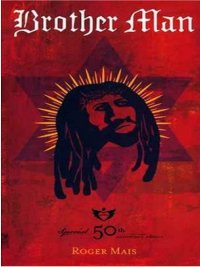
Brother Man by Roger Mais

*A biography about Roger Mais: 

Roger Mais was born on the 11th of August, 1905 in the country of Jamaica. He was a novelist adept at depicting the lives of the unprivileged in such books as ' The Hills Were Joyful Together' and 'Black Lightning'.Mais was also a poet and playwright. By 1951, Mais had won ten first prizes in the West Indian literary competitions. This book 'Brother Man' was originally published in 1954; its a tragic story of an honest Rastafarian healer caught up in a web of intrigue and betrayal in Jamaica's tough West Kingston slums. Roger Mais was left to rest peacefully in the year of 1955.


* Critics view:
Most Critics believed that Roger Mais was interested in symbols stemming almost exclusively from the stories about biblical characters and from Greek mythology. Some also believed that he was trying to bring across a religious view of Rastafarianism.

* The religious view of Rastafarianism:

rasta flag

  • Ratafarianism relies most heavily on certain passages from the King James Bible.
  • Marcus Garvey, born in 1887, would direct the philosophical ideologies that would eventually grow into the Rastafarian movement.
  • As with many other groups which selectively acknowledge biblical passages, the Rastafarians will only accept those parts of the Bible which appear to agree with their unique theological perspectives. 
  • One of the most important aspects of Rastafarianism is its strict belief in the word of the Bible.
  • The rastafarian religion is about love, god, and living life as natural as possible. Rastas have a huge belief in God. As a result we know that love must come first in all things.

Wednesday, September 22, 2010

Literary Terms.

* Prose Fictions:
1. Novel - A fictional prose work with a relatively long and often complex plot, usually divided into chapters.
2. Novellas - A fictional prose work that is longer than a short story but shorter than a novel.
3. Short stories - A variety of small prose fictions with a less complex plot.

* Elements of Prose fictions:
1. Narrative Techniques- The style of telling a "story". Concentrate on the order of events and on their detail in evaluating a writer's technique.
2. Point of view - The perspctive on events of the narrator or a character in a story.
3. Characterization - The way in which the writer potrays the characters in a book, play or movie.
4. Setting - The period in time and place in which the events of a story are said to occur.
5. Theme - The central idea of a story that runs through a text.
6. Plot - The story or sequence of events in something such as a novel, play or movie. the way in which the author arranges events to develope his basic idea.
7. Style - The language of a poem or story primarily literal or figurative. the manner of expression. 
8. Literary devices - An identifiable covention or structure that is employed in literature and story telling.
9. Imagery - Descriptive language that evokes sensory experience. anything appealing to the senses.
10. Syllable - A unit of organization for a sequence os speech sounds.
11. Irony - Humor based on using word to suggest the opposite of their literal meaning.
12. Satire - The experience of the vices and follies of an individual, usually with a view to correcting it.
13. Symbol - Something that on the surface is its literal self but which also has another meanung or even several meanings.
14. Allusion - A brief referance to a person, place, thing, event or idea in history of literature.

* Structural Devices:
1. Stream of consciouness - A narrative mode that seeks to potray an individual point pf view by giving the written equivalent of the character's thought process.
2. Interior monologue - A narrative technique that exhibits the thoughts passing through the minds of protoganists.
3. Flashback - An interjected scene that takes the narrative back in time from the recent or current point the story has reached.
4. Foreshadowing - Hints and clues that suggest the events of what is to come in the action of a play or story.
5. Time frame - A period during which something takes place or is projected to occur.
6. Motif - Any reoccuring element that has a symbolic significance in a story.
7. Juxtaposition - Two objects or texts that oppose one another.

* Types of Fiction:
> Eight types of fictions are:
1. Humorous Fiction
2. Science Fiction
3. Historical Fiction
4. Realistic Fiction
5. Animal Fiction
6. Traditional
7. Mystery.
8. Fantasy

* Literary Context:
1. Social - The indentical or similar social levels and social roles as a whole that influence the individuals of a group.
2. Political - This reflects the environment in which something is produced indicating its purpose or agenda.
3. Religious - This reflects on the beliefs on someone. what a person believes in, their religion.
4. Historical - The time in which something takes place or was created and how that influences, how you interpret it.
5. Ethnic - Reflects on the characteristics of people or a group. sharing common and a distinctive culture. religion or language.
6. Moral - Concerned with the judgement of the goodness and the badness of human action and character.
7. Intellectual - This is the science which deals with mental processes and behaviour.
8. Cultural - the way in which a person grew up. Its also the location where the person lives.